The Right Coffee-to-Water Ratio (Golden Ratio)
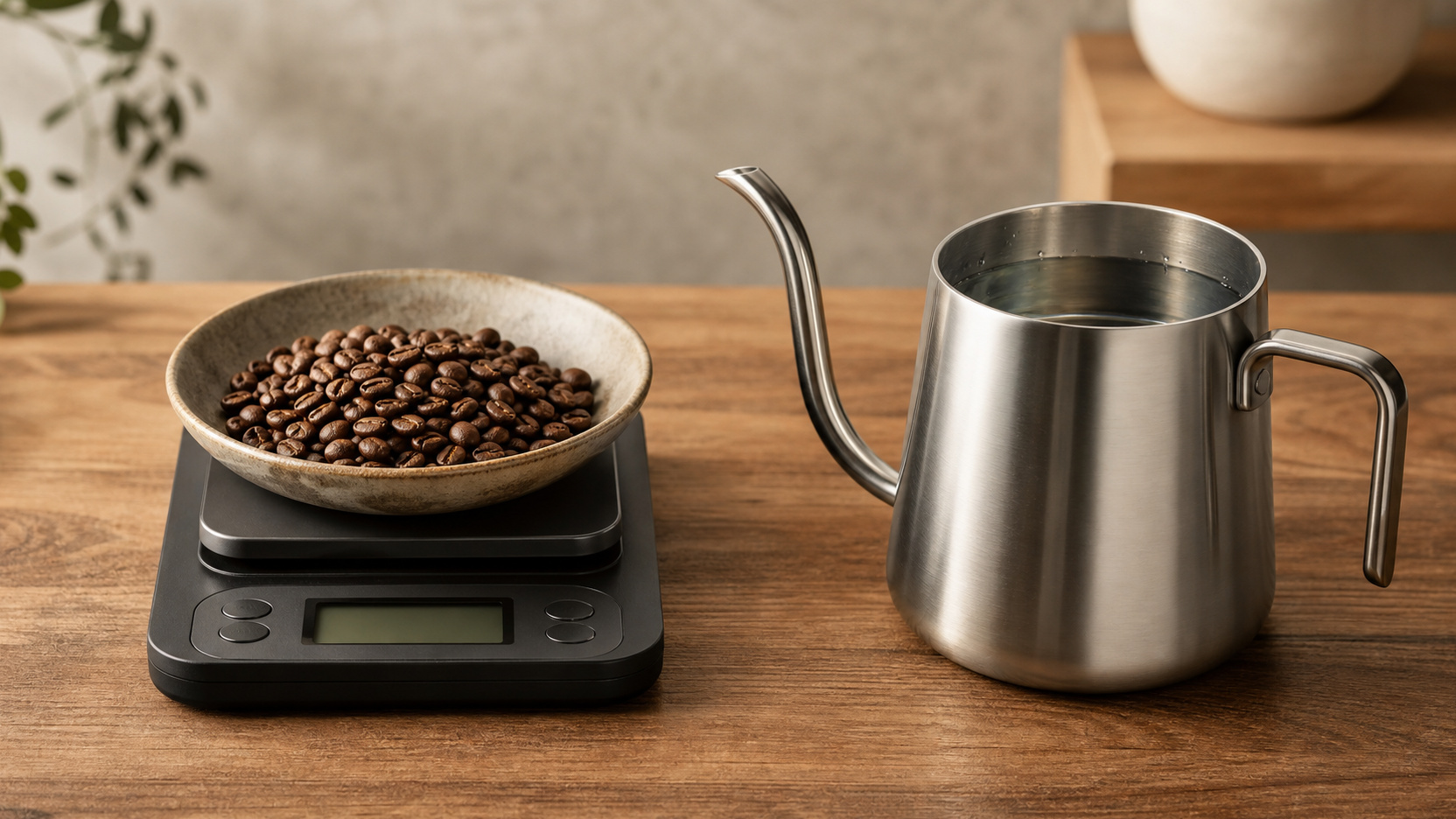
Your coffee-to-water ratio is the single number that decides whether a cup tastes balanced, watery, or overpoweringly strong. This guide is for home brewers who want a consistent cup without turning coffee into a chemistry class. You’ll get the golden ratio, ratios for each brew method, how to measure with or without a scale, and how to adjust it to your own taste.
Why ratio matters more than beans
You can buy wonderful beans and still make a disappointing cup if the coffee-to-water ratio is off. Ratio sets the strength — how much coffee ends up dissolved in your water — and strength is the first thing your tongue notices.
Most weak, watery home coffee isn’t bad coffee; it’s just too little coffee. Nail the ratio and average beans taste good; miss it and great beans taste flat. It’s the cheapest upgrade you’ll ever make, because it costs nothing but a little measuring.
The golden ratio (1:15 to 1:18)
The golden ratio is a starting range of about 1:15 to 1:18 — grams of coffee to grams of water. A 1:15 cup is bold and heavy; 1:18 is lighter and more delicate; 1:16 to 1:17 is the comfortable middle most people enjoy.
To use it, pick your water amount and divide by the ratio. For a 340 g mug at 1:16, that’s about 21 g of coffee. Handily, water weighs almost exactly 1 gram per milliliter, so 340 g of water is 340 ml — one less thing to convert while you brew.
Ratios by brew method
Different brewers taste best at slightly different strengths. Immersion methods such as French press often go a bit stronger, while filter methods sit in the classic range. Here are sensible starting points:
- Pour-over: 1:16 — clean and balanced.
- Drip machine: 1:16 to 1:17.
- French press: 1:15 — fuller and richer.
- AeroPress: 1:14 to 1:16, depending on style.
- Cold brew concentrate: 1:8 to 1:10, then dilute to taste.
Espresso is its own world, measured as a brew ratio of dose to shot weight, usually around 1:2. For everyday brewing, the numbers above will cover you.
Measuring by weight vs scoops
Weighing beats scooping every time. Coffee beans vary in size and density, so a level scoop can swing by several grams — enough to move you a full ratio step. A cheap kitchen scale removes that guesswork.
If you weigh, zero the scale with your empty brewer or mug on it, add coffee to your target dose, then pour water to your target weight. That’s the whole trick. After a few times you’ll recognize your dose by eye and only need the scale to check.
How to adjust to taste
The golden ratio is a launch pad, not a rule. If your coffee tastes too strong or heavy, add water — move from 1:16 toward 1:17 or 1:18. If it tastes weak and watery, add coffee — move toward 1:15.
Adjust the ratio first, and only then start fiddling with grind or time. And keep strength separate from bitterness: a bitter cup is usually about grind, water temperature, or brew time, not the dose — so check the grind size chart if strength isn’t the issue.
A quick reference table
Here’s a cheat sheet you can screenshot. It shows a common coffee-to-water ratio for three mug sizes plus a full carafe, rounded to numbers that are easy to hit on a scale.
| Water | 1:15 (strong) | 1:16 (balanced) | 1:17 (lighter) |
|---|---|---|---|
| 250 g (small mug) | 17 g | 16 g | 15 g |
| 350 g (large mug) | 23 g | 22 g | 21 g |
| 500 g (two mugs) | 33 g | 31 g | 29 g |
| 1000 g (carafe) | 67 g | 63 g | 59 g |
Round to the nearest gram — coffee is forgiving, and a gram either way won’t ruin anything.
No scale? Do this
No scale yet? You can still get close with kitchen spoons. A rounded tablespoon of whole beans is very roughly 7–8 grams of coffee, and most mugs hold about 240–300 ml (8–10 oz) of water.
A workable no-scale starting point is two level tablespoons of ground coffee per 300 ml (10 oz) of water, then adjust: a little more coffee if it’s weak, a little more water if it’s strong. It won’t be as repeatable as weighing, but it beats guessing — and a basic scale is a small, worthwhile upgrade when you’re ready.
Frequently asked questions
What is the golden ratio for coffee?
The golden ratio is about 1:15 through 1:18 — one gram of coffee for every 15 to 18 grams of water. Around 1:16 to 1:17 is the balanced middle most people like. Go lower for a stronger cup and higher for a lighter one.
How much coffee do I use per cup?
For a standard mug of about 350 ml, roughly 20 to 22 grams of coffee at a 1:16 ratio is a solid starting point. If you measure by spoon, that’s about two to three level tablespoons. Adjust up or down until the strength feels right to you.
Does the ratio change with grind or roast?
The ratio sets strength; grind and roast mostly change how that strength extracts and tastes. You can keep the same 1:16 ratio across beans and just adjust the grind if a cup tastes bitter or sour. Dark roasts weigh a little less per scoop, which is one more reason to measure by weight.
Should I weigh the water too?
Ideally, yes — weighing water is more accurate than measuring volume and lets you hit the exact ratio. Conveniently, water weighs about 1 gram per milliliter, so 500 ml is 500 g. If you’d rather not, measure water by volume and just weigh the coffee.
Ratio is the number that quietly makes or breaks a home cup, and it’s the easiest one to control — just weigh, taste, and nudge. Find the strength you love, write it down, and repeat it tomorrow. For how ratio fits with grind, water, and technique, start with our cornerstone guide.
Last updated: July 6, 2026


Comments
Post a Comment