Coffee Grind Size Chart for Every Brew Method
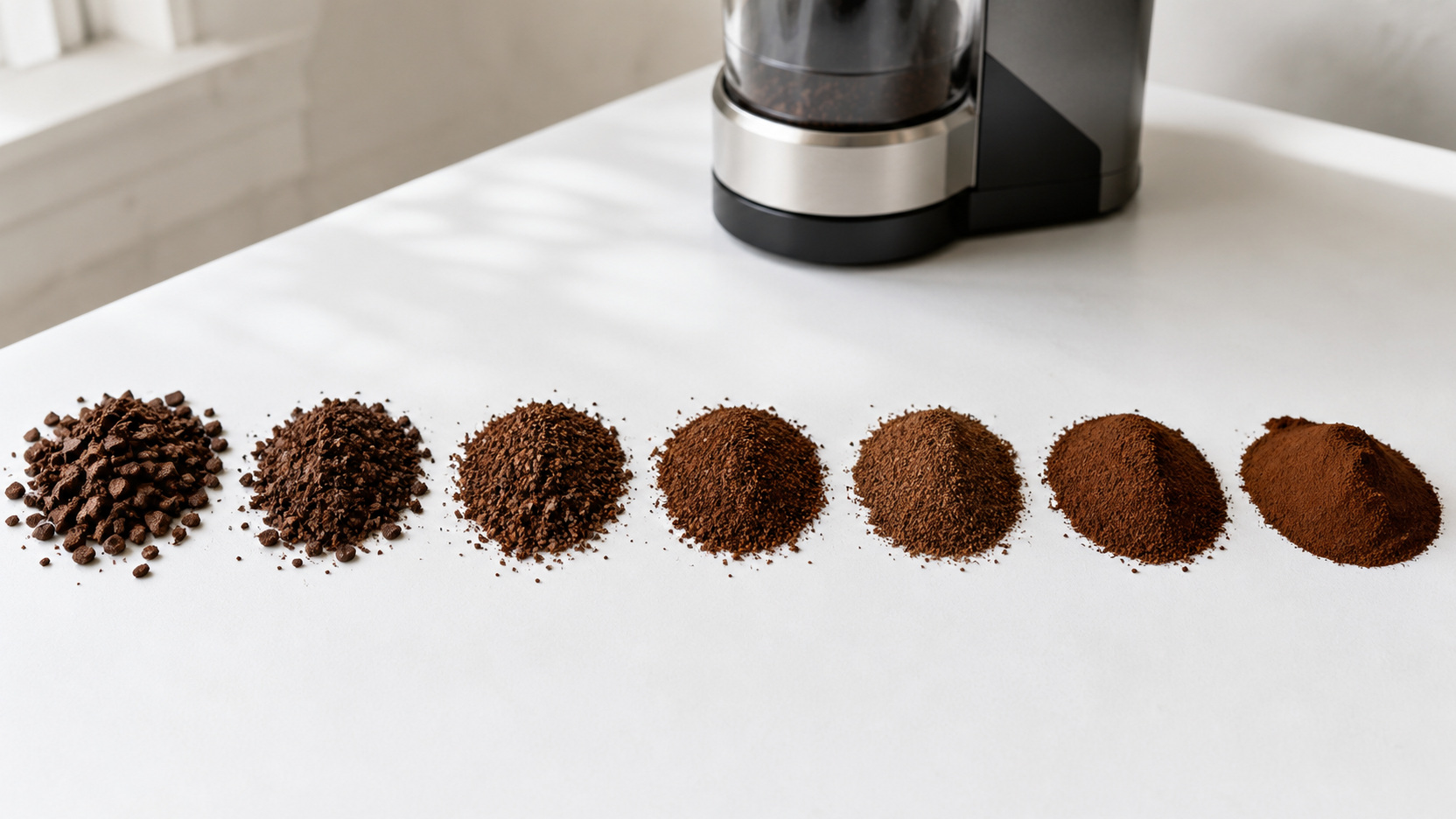
This coffee grind size chart is the reference I wish I’d had when my cups kept coming out bitter or thin for no obvious reason. It’s for any home brewer who owns a grinder and wants to match the grind to the method instead of guessing. You’ll get a method-by-method chart, plain descriptions of what each grind looks like, and how grind quietly steers taste.
Why grind size is the biggest lever
Grind size is the biggest lever you have because it controls how fast water pulls flavor out of the coffee. A coffee grind size chart works because every brewer has a rough contact time — seconds for espresso, minutes for a French press — and the grind has to match it.
Finer grounds have more surface area, so they give up flavor quickly; coarser grounds extract slowly. Get the grind wrong and no ratio or fancy bean will save the cup. Get it right and everything else becomes fine-tuning.
The grind size chart
Here’s the quick chart. Use it as a starting point, then adjust to taste — grinders vary, so a medium setting on your dial may differ from mine.
| Brew method | Grind size | Looks like |
|---|---|---|
| Espresso | Fine | Powdered sugar / table salt |
| Moka pot | Fine–medium | Between table salt and sand |
| AeroPress | Medium–fine | Fine sand |
| Pour-over | Medium | Coarse sand / table salt |
| Drip machine | Medium | Coarse sand |
| French press | Coarse | Coarse sea salt / breadcrumbs |
| Cold brew | Extra coarse | Cracked peppercorns |
These are starting points, not exact numbers — your grinder’s dial is its own language. Brew, taste, and nudge the setting from here.
Fine, medium, coarse — what they look like
You don’t need a lab to judge grind — your fingers and eyes are enough. Rub a pinch between finger and thumb and compare it to something in the kitchen.
- Fine: like powdered sugar or table salt; it clumps slightly and coats your fingers.
- Medium: like coarse sand or table salt; loose and gritty.
- Coarse: like coarse sea salt, kosher salt, or breadcrumbs; distinct, chunky pieces.
The kitchen comparisons aren’t exact, but they get you close enough to brew, taste, and adjust from there.
Matching grind to method
The logic behind the chart is contact time. The longer water sits with the coffee, the coarser the grind should be, so extraction finishes at the right moment instead of running past it.
A quick espresso shot pulls in 25–30 seconds, so it needs a fine grind to extract fast. A French press soaks for four minutes, so it needs a coarse grind or it over-extracts into bitterness. Pour-over and drip sit in the middle at a medium grind. When you switch brewers, switch grind first — you can see it in action in our pour-over guide.
How grind changes taste
Grind is really a taste dial. Grind finer and you extract more — more body, more sweetness, and eventually bitterness if you overshoot. Grind coarser and you extract less — brighter and lighter, but sour and thin if you go too far.
So if a cup tastes harsh and drying, try one notch coarser; if it tastes sharp and sour, try one notch finer. Change the grind alone, brew again, and taste. It’s the fastest way to learn your gear.
Burr vs blade grinders
How you grind matters as much as how fine. A burr grinder crushes beans between two burrs to a consistent size, which is what makes the chart above usable. A blade grinder chops at random, producing dust and boulders at the same time.
| Grinder | Strength | Weakness |
|---|---|---|
| Burr | Even, adjustable, repeatable | Costs more up front |
| Blade | Cheap and common | Uneven grind, hard to dial in |
That unevenness means blade-ground coffee often tastes bitter and sour at once, because the dust over-extracts while the chunks under-extract. A modest burr grinder is the upgrade most home brewers feel immediately.
Dialing it in
Dialing in just means small, deliberate tweaks. Pick your method, set the grind from the chart, brew a cup, and pay attention to the finish.
- Brew a cup at the chart’s suggested grind.
- If it’s bitter or hollow, go one step coarser.
- If it’s sour or thin, go one step finer.
- Change only the grind, and only one step at a time.
Keep a rough note of the setting that tastes best for each brewer. In a few days you’ll have your own chart — the one that matches your grinder and your beans.
Frequently asked questions
What grind size is best for drip coffee?
A medium grind, similar to coarse sand, suits most drip machines and pour-overs. If your drip coffee tastes bitter, go slightly coarser; if it tastes weak or sour, go slightly finer. The paper filter and a few minutes of contact time do the rest.
Can I use the same grind for every brew method?
You can, but you shouldn’t expect the best cup. A grind that’s right for a French press will run sour and thin through espresso, and espresso-fine coffee will clog a drip filter and taste bitter. Match the grind to the method for the biggest jump in quality.
Why does my coffee taste bitter and sour at the same time?
That combination usually points to an uneven grind, most often from a blade grinder. The dust over-extracts into bitterness while the larger chunks under-extract into sourness, and you taste both. A burr grinder fixes it by making the particles a consistent size.
How fine should espresso be ground?
Espresso needs a fine grind, close to powdered sugar or table salt, so water can build pressure and extract in about 25 to 30 seconds. If your shot pours too fast and tastes sour, grind finer; if it drips slowly and tastes bitter, grind coarser. Small adjustments make a big difference at this end of the chart.
Grind is the quiet variable behind most great — and most disappointing — cups at home. Keep this chart handy, trust your taste over the numbers, and adjust one step at a time. When you’re ready to put it to work, our cornerstone guide ties grind, ratio, and technique together.
Last updated: July 6, 2026


Comments
Post a Comment